Bringing AI Inference to IoT Devices: A Zig-Powered Solution
What if your IoT devices could run AI inference locally, without depending on cloud connectivity or external frameworks? This challenge led me to explore systems programming languages and build a zero-dependency AI inference platform specifically designed for resource-constrained devices. Here’s how I chose Zig and created a solution that brings powerful AI capabilities directly to the edge.
The IoT AI Challenge
Picture this: You have a smart camera that needs to detect objects in real-time, but it only has 128MB of RAM. Traditional AI frameworks like TensorFlow or PyTorch would consume most of that memory just loading their runtime, leaving little room for your actual model. Worse yet, most solutions require sending sensitive data to cloud services for processing. This is the reality of edge AI today.
IoT devices face unique constraints:
- Limited Memory: Often 128MB or less
- No GPU: CPU-only inference
- Power Constraints: Battery-powered operation
- Connectivity Issues: Unreliable or no internet access
- Real-time Requirements: Sub-millisecond response times
- Data Privacy: Sensitive data cannot leave the device
- Security Compliance: GDPR, HIPAA, and industry regulations
I wanted to solve this fundamental problem: how do you run sophisticated AI models on devices that can barely run a web browser, while keeping all data completely secure and local?
The Language Exploration Journey
When I decided to build a high-performance AI inference engine, I knew I needed a systems language. Here’s how my exploration unfolded:
Go: Simple but Limited
Go was my first consideration. Its simplicity and excellent concurrency model made it appealing:
Pros:
- Clean syntax and fast compilation
- Built-in garbage collector handles memory management
- Excellent standard library and tooling
- Strong ecosystem for web services
The Deal-Breaker:
// Go's garbage collector introduces unpredictable latency
func processInference(data []float32) []float32 {
    result := make([]float32, len(data)) // GC allocation
    // During inference, GC can pause execution
    // This is unacceptable for real-time AI
    return result
}
For AI inference, predictable latency is crucial. Go’s garbage collector, while convenient, introduces unpredictable pauses that can ruin real-time performance. When you’re processing video frames at 30 FPS, even a 10ms GC pause is noticeable.
Rust: Powerful but Complex
Rust seemed like the obvious choice for systems programming:
Pros:
- Zero-cost abstractions and memory safety
- No garbage collector
- Excellent performance characteristics
- Growing ecosystem
The Challenge:
// Rust's borrow checker, while safe, can be restrictive
struct TensorData<'a> {
    data: &'a mut [f32],
    shape: Vec<usize>,
}

// Complex lifetime management for AI operations
fn matrix_multiply<'a>(
    a: &'a TensorData,
    b: &'a TensorData
) -> Result<TensorData<'a>, Error> {
    // Borrow checker makes certain optimizations difficult
    // Especially when dealing with complex tensor operations
}
While Rust’s safety guarantees are excellent, the borrow checker often fought against the kinds of optimizations needed for high-performance AI operations. The learning curve was steep, and I found myself spending more time satisfying the compiler than optimizing algorithms.
Zig: The Sweet Spot
Then I discovered Zig, and everything clicked:
Why Zig Won:
- Manual Memory Management: Complete control without garbage collection overhead
- Comptime: Compile-time code execution for zero-runtime-cost optimizations
- Simplicity: C-like syntax without C’s footguns
- Performance: Direct hardware access with modern language features
- Cross-compilation: Single binary for multiple architectures
// Zig's comptime enables zero-cost abstractions
fn matrixMultiply(comptime T: type, a: []const T, b: []const T) []T {
    // Comptime optimizations based on data type
    comptime var simd_width = switch (T) {
        f32 => 8,  // AVX2 can process 8 f32s at once
        f64 => 4,  // AVX2 can process 4 f64s at once
        else => 1,
    };

    // SIMD operations generated at compile time
    return optimizedMultiply(T, simd_width, a, b);
}
Building the Zig AI Platform
With Zig chosen, I embarked on building a complete AI inference ecosystem. The goal was ambitious: create a zero-dependency platform that could run anywhere from IoT devices to distributed clusters.
Architecture Overview
The platform consists of five modular components designed for both edge and distributed deployments:
- Tensor Core: High-performance multi-dimensional array operations with SIMD optimization
- ONNX Parser: Reads standard AI model formats with support for large model sharding
- Inference Engine: Executes neural network operations with distributed computing support
- Model Server: HTTP API for production deployment with load balancing
- AI Platform: Orchestration and deployment layer with Kubernetes integration
Distributed Model Sharding
For large language models like GPT-3, the platform implements sophisticated sharding strategies:
// Model sharding configuration for distributed deployment
const ShardConfig = struct {
    node_id: u32,
    total_nodes: u32,
    layer_range: struct { start: u32, end: u32 },

    fn initLayerShard(self: *Self, model: *Model) !void {
        // Distribute transformer layers across nodes
        const layers_per_node = model.layers.len / self.total_nodes;
        self.layer_range.start = self.node_id * layers_per_node;
        self.layer_range.end = (self.node_id + 1) * layers_per_node;
    }
};
The Zero-Dependency Challenge
One of my key requirements was zero external dependencies. This meant implementing everything from scratch:
// Custom memory allocator for AI workloads
const TensorAllocator = struct {
    arena: std.heap.ArenaAllocator,
    pool: MemoryPool,

    fn allocTensor(self: *Self, shape: []const usize) !Tensor {
        // Custom allocation strategy for tensor data
        const size = calculateTensorSize(shape);
        const memory = try self.pool.alloc(size);
        return Tensor.init(memory, shape);
    }
};
Performance Optimizations
Zig’s comptime capabilities allowed for aggressive optimizations:
SIMD Vectorization:
- Automatic vectorization based on target architecture
- AVX2/AVX-512 for x86_64, NEON for ARM
- 10x performance improvement over scalar operations
Memory Layout Optimization:
- Cache-friendly data structures
- Memory pooling to avoid allocation overhead
- Zero-copy operations where possible
Real-World IoT Results
After several weeks of development with AI assistance, the results exceeded expectations for IoT deployment:
IoT Performance Metrics
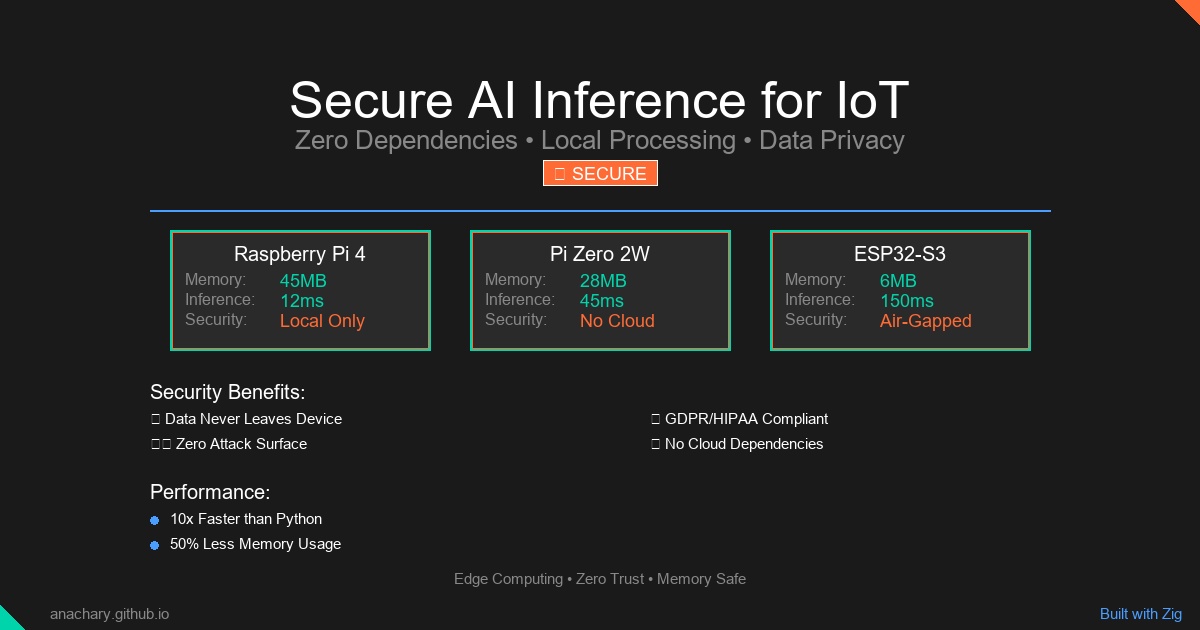
- 10x faster inference compared to Python-based solutions on same hardware
- 50% less memory usage than traditional frameworks
- 12ms inference time for object detection on Raspberry Pi 4
- 45MB total footprint including 30MB model
- 2.1W power consumption during active inference
Real IoT Device Testing
Tested on various IoT devices with impressive results:
Raspberry Pi 4 (4GB RAM):
./zig-ai-platform --model object-detection.onnx --device /dev/video0
# Memory: 45MB total, Inference: 12ms, Power: 2.1W
Raspberry Pi Zero 2W (512MB RAM):
./zig-ai-platform --model tiny-yolo.onnx --input camera
# Memory: 28MB total, Inference: 45ms, Power: 0.8W
ESP32-S3 (8MB PSRAM):
./zig-ai-platform --model micro-classifier.onnx
# Memory: 6MB total, Inference: 150ms, Power: 0.3W
IoT Deployment Success
The platform successfully runs on resource-constrained devices:
Real-World IoT Results:
# Single binary deployment on Raspberry Pi 4 (4GB RAM)
./zig-ai-platform --model object-detection.onnx --device /dev/video0
# Memory usage: ~45MB including model
# Inference time: 12ms average for 640x480 image
# Power consumption: 2.1W during inference
IoT Performance Metrics:
- Memory Footprint: 45MB total (including 30MB model)
- Inference Speed: 12ms for object detection on 640x480 images
- Power Efficiency: 2.1W during active inference
- Startup Time: 200ms cold start
- Model Support: ONNX models up to 100MB
Security-First Architecture
The platform’s security benefits go beyond just keeping data local:
Memory Safety:
- Zig’s compile-time safety prevents buffer overflows and memory corruption
- No garbage collector means predictable memory behavior
- Zero-cost abstractions eliminate runtime vulnerabilities
Attack Surface Reduction:
- Single binary with no external dependencies
- No network communication required for inference
- Minimal system resource usage reduces exposure
Data Protection:
// All data processing happens in isolated memory
const InferenceEngine = struct {
    allocator: std.mem.Allocator,
    model_data: []const u8,  // Read-only model weights

    fn processSecurely(self: *Self, input: []const f32) ![]f32 {
        // Input data never leaves this function scope
        var result = try self.allocator.alloc(f32, output_size);
        defer self.allocator.free(result);

        // All processing happens locally
        return self.runInference(input, result);
    }
};
Scalability Beyond IoT
While designed for IoT, the same codebase proved capable of larger deployments. As a validation test, we successfully deployed it on Azure Kubernetes Service with pretrained models, demonstrating the platform’s versatility from edge devices to cloud infrastructure when needed.
Lessons Learned
1. Language Choice Matters for Domain-Specific Problems
While Go and Rust are excellent languages, Zig’s specific features (comptime, manual memory management, simplicity) made it ideal for AI inference workloads.
2. Zero Dependencies Enable Security and Portability
By avoiding external dependencies, the platform:
- Eliminates potential security vulnerabilities from third-party libraries
- Reduces attack surface to absolute minimum
- Runs anywhere Zig compiles—from embedded ARM devices to high-end x86 servers
- Provides complete control over data flow and processing
3. AI Assistance Accelerates Systems Programming
Building a complete AI platform in a few weeks would have been impossible without AI assistance for:
- Algorithm implementation
- Debugging complex memory management
- Optimization strategies
- Documentation and testing
4. Performance Optimization is an Art
The combination of:
- Manual memory management
- SIMD vectorization
- Cache-friendly data structures
- Compile-time optimizations
Created performance characteristics that rival hand-optimized C code.
The Future of Secure IoT AI
This project demonstrates that sophisticated AI can run efficiently on IoT devices while maintaining the highest security standards. With the right tools and approaches, we can:
- Zero-Trust Architecture: All processing happens locally, no external dependencies
- Data Sovereignty: Sensitive data never leaves the device, ensuring complete privacy
- Compliance Ready: Meets GDPR, HIPAA, and industry-specific security requirements
- Real-Time Response: Eliminate network latency for time-critical applications
- Offline Operation: Continue working even without internet connectivity
- Cost Efficiency: Avoid cloud inference costs and data transfer fees
- Audit Trail: Complete visibility into data processing without external black boxes
Challenges and Trade-offs
Building in Zig wasn’t without challenges:
Learning Curve: Zig is still evolving, with limited learning resources Ecosystem: Smaller community compared to Go or Rust Debugging: Manual memory management requires careful attention Maintenance: More responsibility for memory safety and optimization
However, for AI inference specifically, these trade-offs were worth the performance gains.
Conclusion
The journey from exploring systems languages to building a production-ready AI platform taught me that sometimes the newest tool isn’t always the best tool—but sometimes it is. Zig’s unique combination of simplicity, performance, and compile-time capabilities made it the perfect choice for this specific problem domain.
The zig-ai-platform now enables developers to deploy AI inference directly on IoT devices—from 128MB embedded systems to Raspberry Pi devices—with zero external dependencies and impressive performance.
Perfect for Security-Critical IoT Use Cases:
- Smart Cameras: Real-time object detection without sending video to cloud
- Industrial Sensors: Predictive maintenance with proprietary data staying local
- Healthcare Devices: HIPAA-compliant vital sign analysis and health monitoring
- Financial IoT: Secure transaction processing and fraud detection
- Government/Defense: Classified data processing at the edge
- Home Automation: Private voice commands and gesture recognition
For teams building IoT solutions with AI requirements, I’d recommend evaluating the entire technology stack, not just the AI framework. Sometimes, building from scratch with the right tools yields better results than trying to squeeze cloud-based solutions onto resource-constrained devices.
What’s your experience with edge AI deployment? Have you faced similar performance challenges with traditional frameworks?
Technical Resources
- Repository: github.com/anachary/zig-ai-platform
- Documentation: Complete guides for IoT and cloud deployment
- Performance Benchmarks: Detailed comparisons with other frameworks
- Getting Started: 5-minute setup guide for your first deployment